
Why Buying From Verified Vendors Saves You Money (Even Though It Feels Like the Pricier Option)
Let\'s start with a scene you\'ve probably lived through.
You\'re building a house. Money is already tight — it always is on a construction budget, no matter how carefully you planned it. Someone tells you about a guy who sells cement \"cheaper than the depot down the road.\" No shop, no signage, just a phone number and a truck. You call him. He quotes a price that\'s almost too good to pass up. You place the order, cross your fingers, and move on to the next fifty things on your list.
Three weeks later, that cement doesn\'t set properly. Or the \"granite\" tiles start chipping after two months. Or the guy simply stops picking up your calls after you\'ve paid a deposit for a delivery that never comes.
Sound familiar? You\'re not alone. This is one of the most common — and most expensive — mistakes in construction, and it\'s exactly why the idea of \"verified vendors\" matters so much more than it sounds.
The Hidden Math of \"Cheap\"
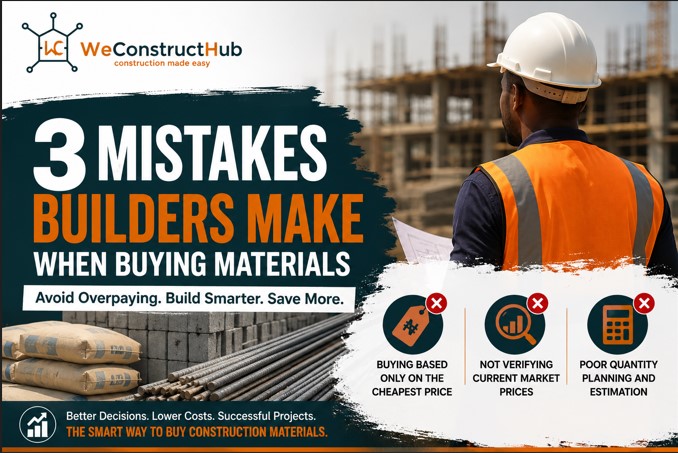
Here\'s the thing nobody tells you when you\'re trying to save money on a project: the cheapest price and the lowest cost are not the same thing.
Cheap price is what you pay today. Low cost is what you actually spend once you add up:
- The materials that failed and had to be replaced
- The labor cost of redoing work twice
- The project delays while you source a replacement
- The stress, time, and transport cost of chasing a vendor who\'s gone quiet
- The structural or safety risk of substandard materials sitting inside your walls
When you add all of that up, that \"cheap\" bag of cement or that bargain batch of blocks often ends up being the most expensive purchase on the entire site.
Verified vendors flip this equation. You might pay what feels like a slightly higher price upfront — but you\'re paying for certainty, and certainty is worth money on a construction project.
What \"Verified\" Actually Means (And Why It\'s Not Just a Badge)
On a platform like WeConstructHub, a verified vendor isn\'t just someone who signed up and uploaded a logo. Verification typically means:
- Their identity and business are confirmed — you\'re not dealing with a ghost number that disappears after payment.
- Their products are checked against quality standards — so \"cement\" actually means cement that meets spec, not a diluted or expired batch.
- They have a track record you can see — reviews, ratings, and transaction history from other buyers, not just their own word.
- There\'s accountability if something goes wrong — a real business with a reputation to protect behaves very differently from an anonymous seller with nothing to lose.
That badge is really a shortcut for something that used to take weeks: due diligence. Before verified vendor marketplaces existed, \"doing your homework\" meant visiting sites, asking around, and hoping your contacts were honest. Now, some of that vetting has already been done for you.
Five Ways Verified Vendors Put Money Back in Your Pocket
1. You Stop Paying for Redos
Substandard materials don\'t fail quietly. They fail expensively — after they\'re already installed, plastered over, or built upon. Ripping out and replacing work costs far more than the material itself; you\'re also paying for labor twice and losing time you didn\'t budget for.
2. You Get Consistent Pricing, Not Guesswork
Unverified sellers often quote based on how desperate you sound, how the market feels that week, or simply what they think they can get away with. Verified vendors on a structured platform operate with transparent, comparable pricing — so you can actually shop around and negotiate with real numbers, not vibes.
3. You Avoid the \"Deposit and Disappear\" Trap
This is painfully common in construction: pay 50% upfront, and the vendor either delivers late, delivers less than agreed, or vanishes entirely. Verified vendors operate within a system that holds them accountable — reviews, ratings, and sometimes escrow-style protections — which makes disappearing a lot harder and a lot riskier for them.
4. You Save Time — Which Is Also Money
Every day your project stalls because a vendor didn\'t deliver, your labor is idle, your rented equipment is idle, and your loan (if you have one) keeps accruing interest regardless. Verified vendors with proven delivery histories reduce the chances of these costly stalls.
5. You Build Long-Term Relationships That Pay Off
A good vendor relationship compounds. Once you find a verified supplier who delivers quality consistently, you can negotiate better rates on repeat orders, get priority during shortages, and skip the anxiety of \"will this batch be different from the last one.\" That trust has real financial value over the life of a project — or a career, if you\'re a contractor doing this repeatedly.
A Quick Story to Make This Real
Think of two builders, both constructing similar 3-bedroom bungalows on a similar budget.
Builder A sources materials from whoever offers the lowest price that week — different vendors, no track record, no consistency. Midway through, a batch of blocks turns out to be understrength. The wall cracks after plastering. He has to break it down, reorder, and redo three weeks of work. His \"savings\" on cheap blocks are wiped out several times over, and his project timeline slips by a month.
Builder B sources through verified vendors. The prices aren\'t always the absolute lowest on paper, but every delivery matches what was promised — right quantity, right quality, right time. No surprises, no redos, no idle site. When you total up both projects at completion, Builder B comes out ahead — not because he spent less per item, but because he didn\'t pay twice for anything.
That\'s the real lesson: saving money in construction isn\'t about finding the lowest number. It\'s about eliminating the expensive surprises.
So, How Do You Actually Use This?
If you\'re sourcing materials for your next project, a few simple habits go a long way:
- Prioritize verified vendors first, even if a slightly cheaper unverified option is tempting.
- Check reviews and ratings before committing to a large order — patterns in feedback tell you more than a single conversation ever will.
- Compare like-for-like specs, not just prices — cheap and low-quality often hide behind vague product descriptions.
- Start with a smaller trial order from a new vendor before committing to your full material list.
- Keep a record of every transaction — verified platforms make this easy, and it protects you if disputes arise.
The Bottom Line
Buying from verified vendors isn\'t about playing it safe for the sake of it — it\'s a genuine cost-saving strategy dressed up as a quality decision. Every naira, dollar, or cedi you \"save\" by cutting corners on vendor verification has a way of finding its way back into your budget as a problem — usually a bigger one than the amount you originally saved.
The next time you\'re comparing a bargain price against a verified vendor\'s slightly higher quote, ask yourself: what\'s the real cost if this goes wrong? More often than not, the verified vendor was the cheaper option all along — you just hadn\'t done the full math yet.
Sourcing materials for your next project? Explore verified vendors on WeConstructHub and buy with confidence, not crossed fingers.



Comments
No comments yet..!
Write a Comment