
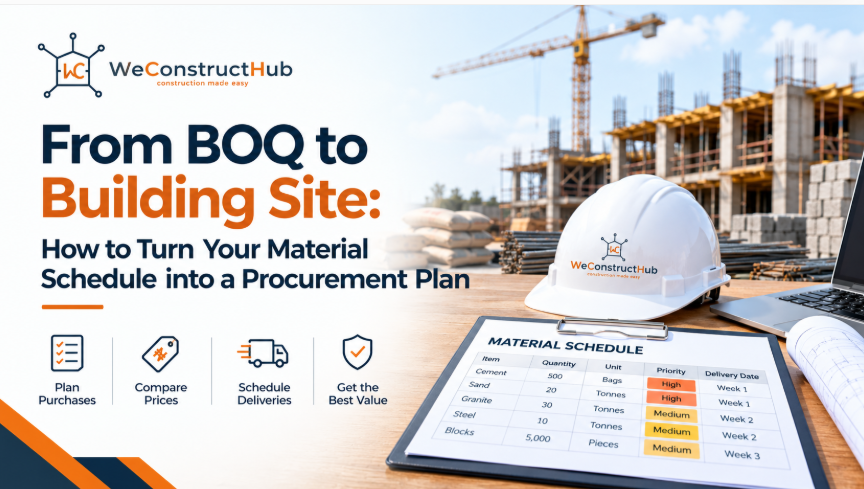
From BOQ to Building Site: How to Turn Your Material Schedule into a Procurement Plan
Introduction
A construction project can have a well-prepared Bill of Quantities (BOQ), competent professionals and an approved budget and still experience delays, unexpected costs and material shortages.
Why? Because knowing the materials required for a project is not the same as having a plan for purchasing and delivering them.
A BOQ helps establish the quantities and costs associated with construction work. A procurement plan takes those requirements further by determining what materials need to be purchased, when they will be needed, how much should be ordered, which suppliers to consider and how deliveries will be coordinated with site activities.
In Nigeria, where construction material prices, transportation costs and supplier availability can vary, proper procurement planning is essential for keeping projects organised and making informed purchasing decisions.
Whether you are building your first home, managing a residential development or working as a quantity surveyor or contractor, understanding how to move from a BOQ to a practical procurement plan can help you manage your resources more effectively.
In this guide, we explain the process step by step and how WeConstructHub can help you source construction materials and compare vendor prices to get better value for your money.
What Is the Difference Between a BOQ and a Procurement Plan?
A Bill of Quantities is a document that describes and quantifies construction work items, usually with their units, quantities and, where applicable, rates and amounts. Its format and level of detail depend on the project and how the document was prepared.
A procurement plan, on the other hand, explains how the resources required for the project will be obtained and delivered in line with the construction programme.
The two documents serve different but connected purposes.
A BOQ helps answer questions such as:
What work needs to be carried out?
What quantities have been measured?
What materials and other resources are required?
What costs have been allowed for in the estimate?
A procurement plan helps answer:
What materials need to be purchased first?
When will each material be required on site?
What quantities should be ordered at each stage?
Which suppliers offer suitable products and competitive overall prices?
How will transportation, storage and delivery be managed?
The BOQ provides an important starting point, but it should not be treated as an instruction to purchase every listed material immediately. Actual purchasing decisions should reflect the construction programme, available funds, specifications, site conditions and current market information.
Step 1: Review the BOQ and Confirm the Project Requirements
Before contacting suppliers or placing orders, review the BOQ carefully.
The first objective is to understand what the project requires and ensure that the information being used for procurement is sufficiently clear.
Pay attention to the following:
Material descriptions and specifications: Identify the required material types, sizes, grades, dimensions, standards and other relevant specifications. Similar-looking products may not be interchangeable.
Quantities and units: Confirm whether quantities are expressed in tonnes, kilograms, cubic metres, square metres, linear metres, bags, pieces or another unit. These units must be understood before requesting quotations.
Scope and omissions: A BOQ may not provide every purchasing detail needed by a supplier. Additional schedules, drawings, specifications or clarification from the design team may be necessary.
Current project requirements: Check whether drawings or specifications have changed since the BOQ was prepared. Procurement should follow the latest approved project information.
If you are a homeowner working with a contractor or quantity surveyor, ask for clarification before purchasing materials you do not fully understand.
Ordering the wrong product or quantity can create avoidable expenses, even when the quoted price appears attractive.
Step 2: Convert the BOQ into a Material Procurement Schedule
Once the requirements have been reviewed, identify the materials that must be sourced and organise them into a procurement schedule.
The purpose is to turn information about construction work into a practical list of purchasing requirements.
Depending on the project, the schedule may include:
Material description and specification.
Required quantity and unit of measurement.
Construction activity or work package.
Expected date of use on site.
Quantity to be ordered at each stage.
Estimated budget or applicable cost allowance.
Supplier quotation and availability details.
Planned delivery date and delivery status.
Not every project will require the same level of documentation. A small residential project may use a simple spreadsheet, while a larger development may require a more detailed procurement register linked to the construction programme.
The important thing is that material requirements are clearly documented and connected to the activities they support.
This makes it easier to track what has been purchased, what is still outstanding and what needs attention before it affects site progress.
Step 3: Prioritise Materials According to the Construction Programme
One of the most common procurement mistakes is buying materials without considering when they will actually be needed.
A construction project progresses through different stages, and each stage has its own material requirements.
For example, foundation works may require excavation-related resources, reinforcement, concrete materials and formwork, depending on the approved design. Later stages may require blocks, roofing materials, electrical installations, plumbing products, doors, windows and finishing materials.
The exact sequence will depend on the project.
Use the construction programme to determine when materials are needed and work backwards to establish when orders should be placed. Consider supplier lead times, delivery arrangements, approvals and the time required to inspect materials on arrival.
Materials with long lead times or limited availability may need to be ordered earlier than ordinary items.
However, early procurement must be balanced against storage capacity, security, cash flow and the risk of damage or deterioration.
The objective is not to purchase everything as early as possible. It is to ensure that the right materials are available when the work requires them.
Step 4: Determine the Quantities to Purchase at Each Stage
The quantities stated in a BOQ provide an important reference, but they do not automatically determine the quantity of every purchase order.
The purchasing quantity should be established by reviewing the relevant work requirements, material take-off, available stock, approved changes and any justified allowance for wastage.
For instance, a project may require a total quantity of a particular material, but that material may be needed across several weeks or construction stages. The procurement plan can divide the requirement into appropriate orders rather than purchasing the entire quantity at once.
Before confirming an order, consider:
The quantity required for the next work stage.
Materials already available on site.
Expected consumption before the next delivery.
Supplier minimum order quantities, where applicable.
Storage and handling limitations.
The cost and practicality of multiple deliveries.
Any approved allowance for cutting losses, breakages or other wastage.
Avoid adding arbitrary quantities simply to be safe. Excess purchasing can tie up funds, increase storage requirements and create avoidable losses.
Where the BOQ, drawings or site conditions are unclear, consult the relevant construction professional before finalising the order.
Step 5: Compare Supplier Prices and Assess Value for Money
After identifying the materials and quantities required, the next step is to obtain quotations and evaluate suitable suppliers.
This is where procurement planning can make a significant difference to the project budget.
However, the lowest quoted price does not always represent the best purchasing decision. Two suppliers may quote different prices because of differences in specifications, product quality, delivery arrangements, payment terms or availability.
For a meaningful comparison, ensure that the quotations relate to the same material specification and comparable quantities.
Consider the following when reviewing supplier offers:
Unit price: What is the supplier charging per bag, tonne, cubic metre, length or piece?
Transportation: Is delivery included, or will it be charged separately?
Offloading and handling: Are there additional costs associated with getting the materials into the required storage area?
Availability and lead time: Can the supplier deliver when the project needs the materials?
Product suitability: Does the offered material meet the project\'s approved specifications?
Payment terms: What payment arrangements apply, and are they appropriate for your project?
Quotation validity: How long will the quoted price remain valid?
Where relevant, compare the total cost of getting the required materials to the site, rather than looking at the material price alone.
This helps you make decisions based on the overall value offered by each supplier.
How WeConstructHub Can Help
You do not have to contact multiple vendors and compare every quotation on your own.
Through WeConstructHub, customers can share their construction material requirements and get assistance comparing prices from our vendors to identify options that offer good value for money.
Alternatively, you can visit the WeConstructHub marketplace and shop for construction materials directly on the website.
These options give customers flexibility in how they approach procurement, whether they prefer assistance with price comparisons or want to browse available products themselves.
The goal is to make sourcing construction materials easier and help customers make more informed purchasing decisions.
Explore the marketplace at shop.weconstructhub.com.
Step 6: Plan Deliveries Around Site Readiness
A procurement plan should account for more than the date an order is placed. It should also consider when the site will be ready to receive and use the materials.
Deliveries that arrive too early can create storage, security and handling problems. Deliveries that arrive too late can interrupt work and leave labour or equipment underutilised.
Before confirming a delivery, consider:
Whether the relevant work area is ready.
Whether the site has sufficient storage space.
Whether delivery vehicles can access the site.
Whether labour or equipment will be available to offload the materials.
Whether weather conditions may affect access or storage.
Whether the delivery date aligns with the construction programme.
For projects with limited storage space, coordinate deliveries more closely with the sequence of work.
Where multiple deliveries are necessary, ensure that the arrangements are practical and that the additional transportation costs have been considered.
Clear communication between the project team, supplier and site personnel helps reduce misunderstandings and unnecessary delays.
Step 7: Inspect and Reconcile Materials on Arrival
The procurement process does not end when a supplier delivers the order.
Materials should be checked against the purchase order, approved specifications and delivery documentation.
Depending on the material, the checks may include quantity, dimensions, product identification, visible condition and other relevant acceptance requirements.
If a discrepancy is identified, document it promptly and communicate it to the appropriate parties before the issue becomes more difficult to resolve.
Maintain records such as purchase orders, supplier quotations, invoices, delivery notes and inspection records, as applicable to the project.
These records help establish what was ordered, what was delivered, what was accepted and what remains outstanding.
It is also important to update the procurement schedule after each delivery. This gives the project team a clearer picture of materials received, outstanding orders and future purchasing requirements.
For materials that require specialist testing or technical inspection, follow the project\'s specifications and applicable professional requirements rather than relying on a visual check alone.
Step 8: Monitor Procurement Against the Budget
As the project progresses, compare actual procurement costs with the applicable budget or cost allowance.
Differences may arise because of price changes, transportation costs, specification changes, quantity adjustments or other project circumstances.
Record these differences and investigate their causes.
For example, if a material costs more than originally allowed, establish whether the difference results from a market price change, a change in specification, an earlier estimating assumption or another factor.
Where appropriate, review alternative suppliers and delivery arrangements, provided that the required specifications and quality standards are maintained.
Do not automatically substitute a cheaper material without obtaining the necessary technical and project approvals.
A useful procurement review should show:
Materials already purchased.
Amounts committed through outstanding orders.
Materials still required.
Outstanding deliveries.
Differences between estimated and actual costs.
Upcoming purchasing decisions.
Regular reviews help identify problems early and support better decisions about the remaining project budget.
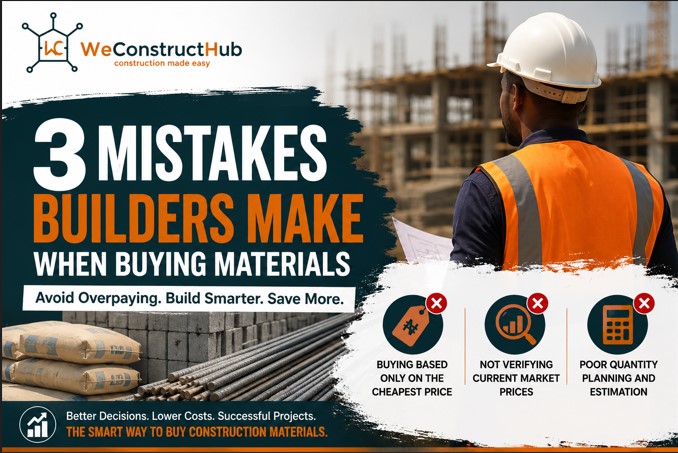
Common Mistakes to Avoid When Turning a BOQ into a Procurement Plan
Even a well-prepared BOQ can be undermined by poor procurement practices.
Avoid these common mistakes:
1. Purchasing everything at once: Bulk purchasing may be appropriate in some circumstances, but only after considering price, storage, cash flow and actual project requirements.
2. Using outdated prices: A rate recorded during estimating may no longer reflect current supplier prices. Confirm applicable quotations before committing funds.
3. Comparing different specifications: A cheaper product is not necessarily a suitable substitute for the material specified.
4. Ignoring delivery costs: Transportation, offloading and other applicable charges can affect the overall cost of procurement.
5. Failing to coordinate with site activities: Materials should be available when required without unnecessarily crowding the site or tying up working capital.
6. Neglecting documentation: Without proper records, it becomes harder to reconcile quantities, monitor expenditure and resolve disputes.
7. Waiting until materials are urgently needed: Last-minute purchasing can reduce the time available to compare suppliers and coordinate deliveries.
A structured procurement plan helps reduce these risks, although project-specific decisions will still depend on the construction programme, available resources and market conditions.
Conclusion: Make Every Procurement Decision Count
Moving from a BOQ to a practical procurement plan requires more than extracting quantities and requesting prices. It involves understanding the project requirements, prioritising purchases, comparing suitable suppliers, coordinating deliveries and monitoring expenditure throughout construction.
When these activities are properly coordinated, contractors and developers can make better-informed purchasing decisions, while homeowners can gain a clearer understanding of how their construction budgets are being spent.
You do not need to manage every supplier conversation and price comparison manually.
WeConstructHub makes construction material procurement easier. Share your material requirements with us and let us help you compare vendor prices for better value for money, or visit our online marketplace to browse and shop for the materials you need.
Visit shop.weconstructhub.com and take a more organised approach to sourcing construction materials.
WeConstructHub — Procurement Made Easy.











Comments
No comments yet..!
Write a Comment