
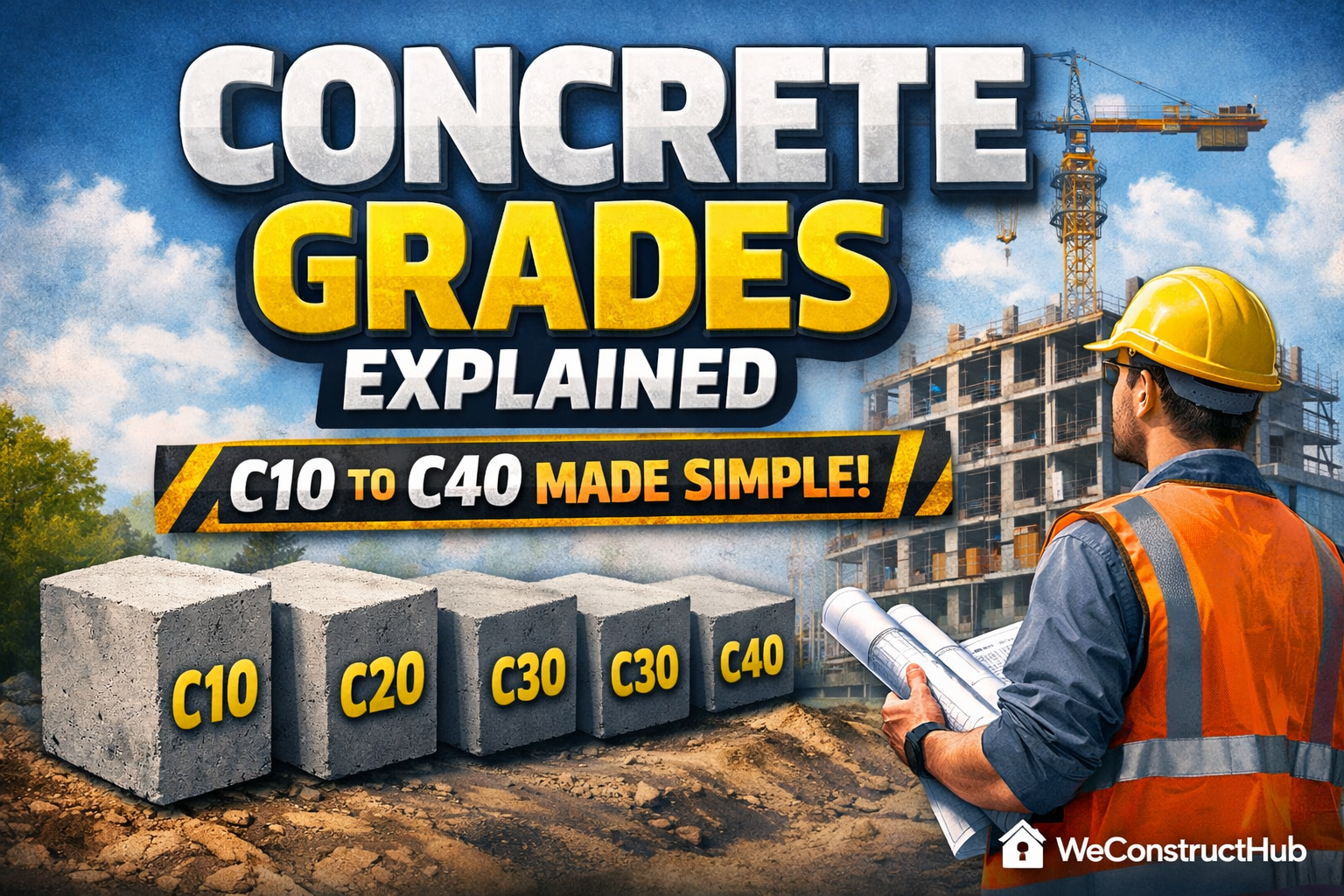
Concrete Grades Explained: C10 to C40 Made Simple for Builders and Engineers
Concrete is the backbone of construction, but many people on site still misunderstand what concrete grades actually mean. Whether you\'re a student, builder, or engineer, understanding concrete grades is essential for safe and cost-effective construction.
This guide breaks down everything you need to know in a simple and practical way.
📌 What Are Concrete Grades?
Concrete grades represent the compressive strength of concrete measured after 28 days of curing, expressed in N/mm² (Newton per square millimetre).
For example:
- C20 concrete means the concrete can withstand 20 N/mm² of compressive force.
The “C” stands for Concrete Class, and the number represents its strength.
🧪 Concrete Grades and Their Uses
🟢 C10 Concrete
- Very low strength concrete
- Uses: blinding, leveling, kerbs, non-structural works
- Not suitable for load-bearing structures
🟡 C15 Concrete
- Low-strength concrete
- Uses: floor blinding, mass concrete, simple foundations
- Light-duty applications only
🔵 C20 Concrete
- Medium-low strength concrete
- Uses: small residential foundations, slabs, driveways
- One of the most commonly used grades in housing
🟠 C25 Concrete
- Medium strength concrete
- Uses: beams, columns, slabs in residential buildings
- Good balance of strength and cost
🔴 C30 Concrete
- High-strength structural concrete
- Uses: multi-storey buildings, heavy slabs, structural columns
- Common in commercial construction projects
⚫ C35 – C40 Concrete
- Very high strength concrete
- Uses: bridges, heavy infrastructure, high-rise buildings
- Designed for durability and heavy load resistance
🏗️ Common Site Mix Ratios (Practical Guide)
Although engineers prefer design mixes, site batching is still common:
- C10 → 1:4:8
- C15 → 1:3:6
- C20 → 1:2:4
- C25 → 1:1.5:3
- C30+ → Designed mix (lab tested)
⚠️ Note: Strength depends not only on ratio but also on:
- Water-cement ratio
- Compaction
- Curing quality
- Material quality
⚠️ Common Mistakes on Construction Sites
- Using lower grade concrete to reduce cost
- Adding excess water for easier mixing
- Poor curing practices
- Ignoring engineer specifications
These mistakes can reduce concrete strength significantly and lead to structural failure.
📊 Quick Summary Table
| Grade | Strength Level | Typical Use |
|---|---|---|
| C10–C15 | Low | Non-structural works |
| C20–C25 | Medium | Residential buildings |
| C30–C40 | High | Commercial & heavy structures |
🧠 Final Thoughts
Choosing the right concrete grade is not just about cost — it directly affects safety, durability, and structural performance.
For builders and professionals, understanding these grades helps avoid costly mistakes and ensures long-lasting structures.
At WeConstructHub, we aim to simplify construction knowledge and make it accessible for everyone in the built environment.













Comments
Mary Lumi 05 Jun 2026 04-07:pm
Love this
Write a Comment