
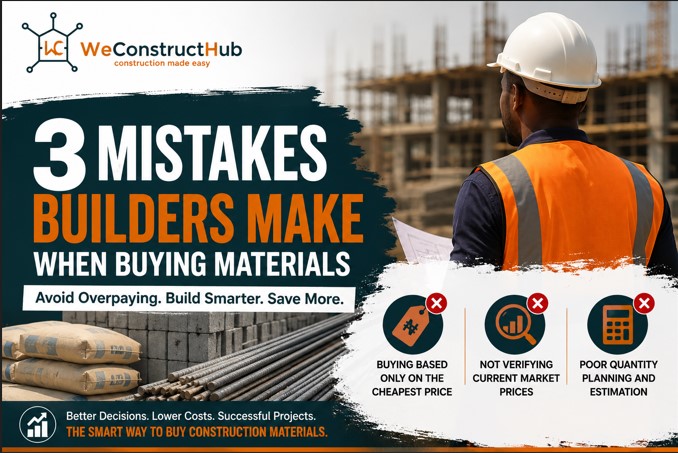
3 Mistakes Builders Make When Buying Construction Materials That Quietly Destroy Project Profits
Overpaying due to poor sourcing is one of the fastest ways builders lose money on site. It rarely shows up as a single obvious mistake. Instead, it appears gradually through inflated purchase costs, repeated wastage, and unexpected budget overruns that could have been avoided from the start.
In construction, materials often account for more than half of the total project cost. This means procurement decisions directly influence whether a project stays profitable or becomes a financial struggle. Unfortunately, many cost problems do not come from design or execution. They start right at the point of buying materials.
Below are three critical mistakes builders make when purchasing construction materials and how to avoid them.
1. Buying Materials Based Only on the Cheapest Price
On many construction sites, the first instinct when sourcing materials is to go for the cheapest supplier. At surface level, this looks like good cost control. But in reality, it is one of the most expensive decisions in the long run.
A contractor may choose a lower priced cement supplier or cheaper blocks, believing they are saving money. However, when those materials fail to meet proper standards, the consequences start to appear on site. Blocks may crumble during laying, cement may underperform in strength tests, or reinforcement may not meet specification requirements. This leads to rework, delays, and additional labour costs that were never planned for.
For example, a project that saves a small amount on each bag of cement can end up spending significantly more when structural elements need correction or when curing fails and sections have to be redone.
The reason this mistake is common is simple. Many builders focus on immediate cash flow pressure instead of long term performance. There is also limited verification of supplier credibility in informal procurement environments.
The better approach is to evaluate materials based on value rather than price alone. Value includes quality consistency, supplier reliability, compliance with specifications, and delivery assurance. A slightly higher upfront cost is often more profitable than repeated corrections later.
2. Not Checking Current Market Prices Before Purchasing
Another major issue in material procurement is relying on outdated price information or guesswork. Construction material prices are not static. They change frequently due to transportation costs, fuel prices, demand fluctuations, and supply chain disruptions.
Many builders still depend on old quotations or verbal pricing from familiar suppliers. Others simply accept the first price they are given without comparing alternatives. This creates room for overpricing and exploitation, especially when the buyer has no reference point for current market rates.
This is where overpaying due to poor sourcing becomes very clear. Two suppliers may be offering the same material, but the difference in pricing can significantly affect project cost, especially on large volume purchases like cement, granite, sand, and reinforcement steel.
For instance, even a small price difference per tonne of steel can translate into hundreds of thousands of naira on a medium sized project. Without proper market awareness, the builder has no negotiation advantage and ends up accepting inflated rates.
This mistake usually happens because there is no structured system for tracking material prices. In many cases, procurement decisions are rushed due to site pressure and delivery urgency.
The solution is simple but powerful. Builders must always verify current market prices before committing to purchase. Comparing multiple suppliers and having a reliable price reference system improves negotiation strength and prevents unnecessary overspending.
Platforms like WeConstructHub are designed to help professionals stay informed with updated construction material price insights so decisions are based on real market conditions rather than assumptions.
3. Poor Quantity Planning and Inaccurate Material Estimation
One of the most silent but damaging mistakes in construction procurement is buying materials without proper quantity planning. This usually happens when there is no detailed Bill of Quantities or when site estimation is done casually without structured measurement.
The result is either over ordering or under ordering. Both situations create financial loss.
Over ordering leads to unused materials sitting on site, increasing wastage, risk of theft, and tied up capital that could have been used elsewhere. Under ordering is even more disruptive because it causes delays, emergency purchases, and often higher prices due to urgent sourcing.
For example, a contractor who miscalculates block requirements may end up ordering more than needed or making repeated trips to purchase additional quantities at higher transport and material costs. In large projects, these small inefficiencies accumulate into significant budget variance.
This mistake is common because many builders rely on rough estimates or experience based judgment rather than structured quantity surveying methods. In some cases, drawings are not properly measured before procurement begins.
The professional solution is accurate material take off before any purchase is made. This includes proper measurement from drawings, preparation of a Bill of Quantities, and using estimation tools that reduce human error.
When procurement is guided by accurate data, waste reduces, budgeting becomes more predictable, and project execution becomes smoother.
Conclusion
Most construction budget problems do not begin during execution. They begin at the point of purchase.
Builders who avoid these three mistakes tend to experience more control over their projects. They reduce wastage, improve cost accuracy, and maintain healthier profit margins.
Smarter procurement is not about spending less. It is about spending correctly based on accurate information, proper planning, and reliable market data.
This is why modern construction professionals are gradually moving towards data driven decision making in procurement, where tools and platforms support better pricing awareness and quantity accuracy.
WeConstructHub exists to support that shift by making construction pricing information, estimation resources, and industry insights more accessible to professionals who want to build more efficiently and profitably.







Comments
No comments yet..!
Write a Comment