
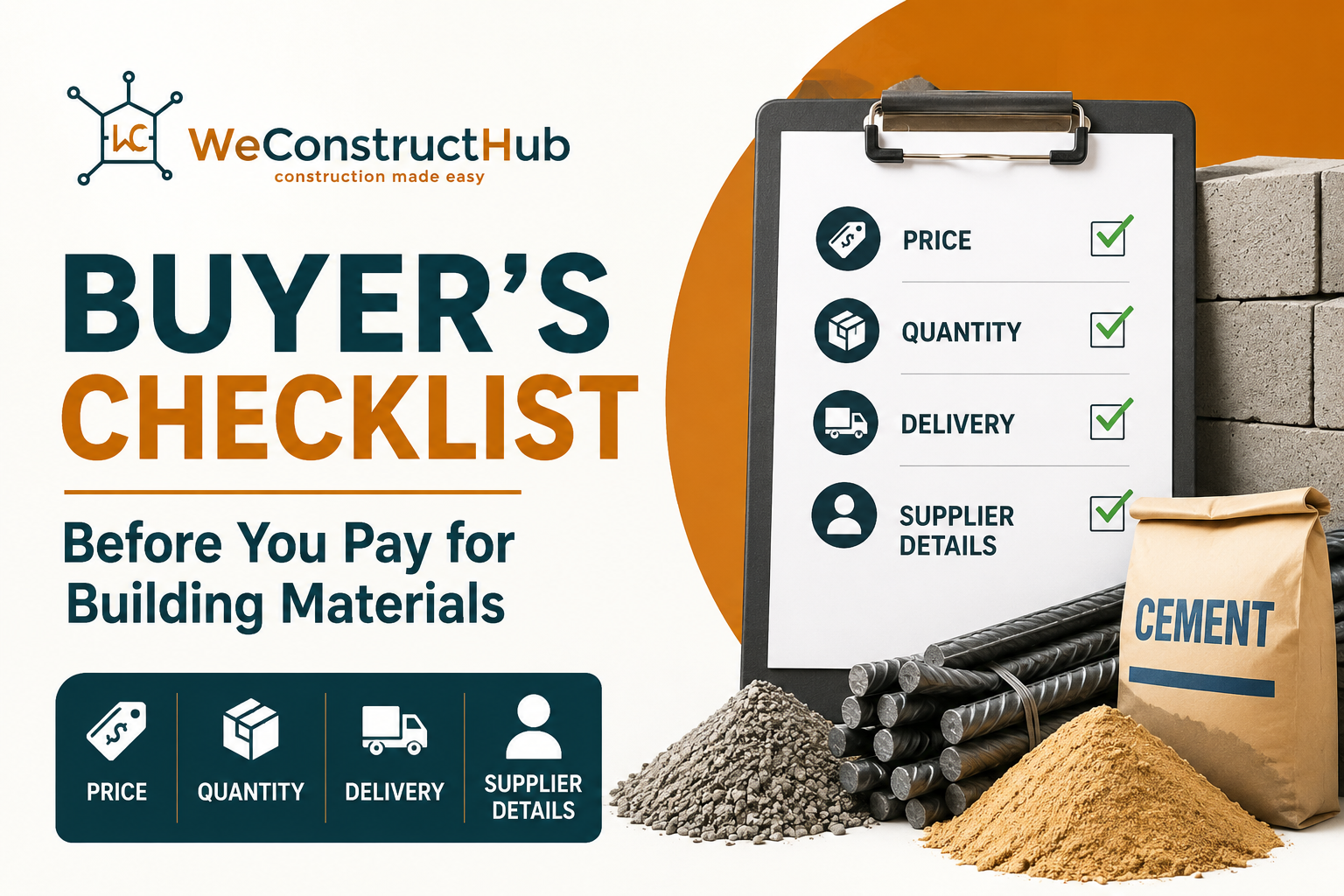
Buyer’s Checklist: 7 Things to Confirm Before Paying for Building Materials
Buying building materials sounds simple: find a supplier, agree on a price, make payment, and wait for delivery.
But anyone who has managed a construction project knows it is rarely that simple.
A material that looks affordable at first can become expensive when you factor in delivery charges, inaccurate quantities, changing prices, poor-quality materials, or unexpected fees.
Whether you are a contractor, developer, Quantity Surveyor, homeowner, or project manager, never rush to make payment simply because you found a good price.
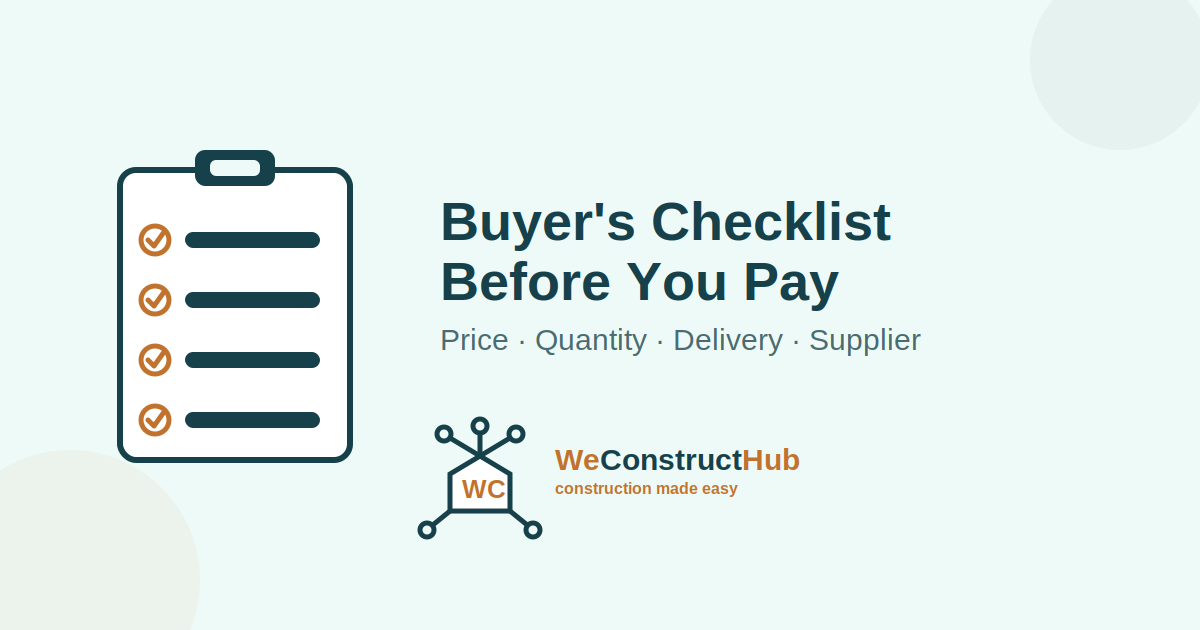
Before you transfer your money, run through this checklist.
1. Confirm the Price
The first question is obvious: How much is it?
But don\'t stop there.
Confirm exactly what the quoted price represents. Is it the price per bag, tonne, trip, piece, or square metre? Is the price still current? Has delivery been included?
Construction material prices can change, so a quotation you received several days ago may no longer reflect the current market price.
For example, if you are purchasing granite, don\'t simply ask for the price. Confirm:
Price per tonne or trip
Quantity being supplied
Delivery cost
Location of delivery
Any additional charges
How long the quoted price is valid
Never compare prices without comparing what is included in those prices.
A supplier offering a lower material price may ultimately cost you more if their delivery or other charges are significantly higher.
2. Confirm the Quantity
Getting the right price for the wrong quantity is still a bad deal.
Before making payment, confirm exactly how much material you are buying and how that quantity will be measured.
Depending on the material, this could be:
Bags of cement
Tonnes of reinforcement
Trips of sand
Tonnes of granite
Number of blocks
Pieces of roofing sheets
Cubic metres of materials
Your purchase should correspond with your project\'s actual requirement.
If your project requires 500 bags of cement, for example, make sure the supplier\'s quotation clearly states 500 bags, not simply \"cement supply.\"
Clear quantities reduce misunderstandings and make it easier to verify what was delivered.
3. Confirm the Material Quality and Specification
A low price is not a bargain if the material does not meet the required specification.
Before payment, confirm that the material you are purchasing is suitable for its intended use.
For materials such as reinforcement, cement, blocks, roofing sheets and other specified products, pay attention to the required:
Grade + size + specification + quantity + quality.
This is particularly important when materials have different grades, sizes, strengths, or specifications that can significantly affect their price and performance.
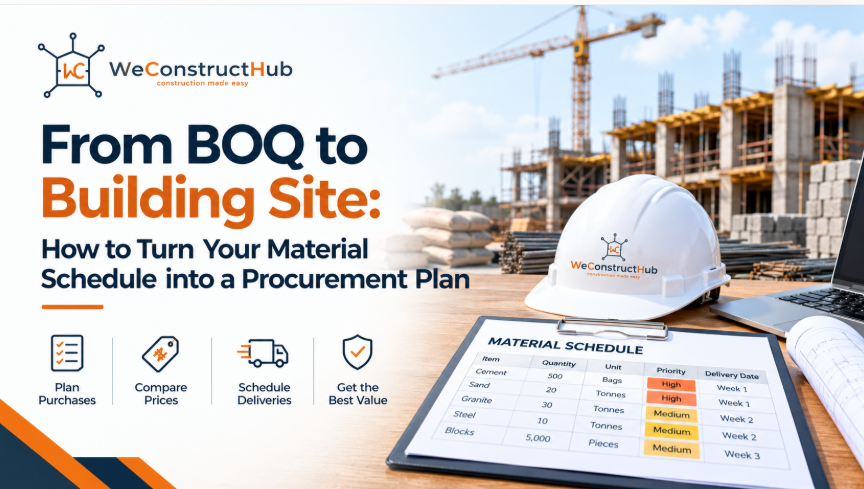
If your project has drawings, specifications, or a Bill of Quantities (BOQ), use them as a reference before ordering.
4. Confirm Delivery
You have agreed on the material price. Great.
But how much will it cost to get the material to your site?
And when will it arrive?
Before payment, confirm:
Delivery cost
Delivery date
Delivery location
Transport arrangement
Offloading arrangements
Site access requirements
Any applicable gate, union, or access fees
These costs can sometimes be overlooked when comparing supplier prices.
For example, Supplier A may quote ₦700,000 while Supplier B quotes ₦730,000. If Supplier A charges an additional ₦80,000 for delivery while Supplier B includes delivery, Supplier B may actually be the better deal.
Always compare the final landed cost, not just the material price.
5. Verify the Supplier
Before transferring a significant amount of money, take a moment to establish who you are paying.
A good price does not automatically mean a reliable supplier.
Where possible, verify:
The supplier\'s business identity
Contact details
Physical/business presence
Previous customer experience
Supplier references
Payment/account details
Be especially careful when a supplier is putting pressure on you to make immediate payment because of a supposedly \"limited-time\" price.
If something doesn\'t feel right, pause and verify before paying.
A few minutes of verification can save you from a very expensive mistake.
6. Put the Agreement in Writing
A phone conversation is not enough when significant money is involved.
Before payment, ensure the important details are documented.
Your purchase agreement, quotation, invoice, or order confirmation should clearly state:
Material + Quantity + Unit Price + Total Cost + Delivery + Payment Terms + Delivery Date
This creates a clear record of what both parties agreed to.
If there is a change in price, quantity, specification, or delivery arrangement, document the change as well.
Clear documentation protects both the buyer and the supplier.
7. Compare Before You Pay
This is one of the most important steps.
Don\'t buy simply because you found a supplier. Buy because you understand the deal.
Before making payment, compare your options.
Look at:
Current market price
Supplier price
Quantity
Material specification
Delivery cost
Supplier reliability
Total cost
You don\'t necessarily need to contact ten different suppliers every time you want to buy materials.
You simply need access to reliable information that helps you know whether the price you are being offered makes sense.
Your 30-Second Buyer’s Checklist
Before you transfer money for building materials, ask:
☐ Is the price current?
☐ Is the quantity correct?
☐ Is the material specification correct?
☐ Is the quality suitable for my project?
☐ Is delivery included?
☐ Are there additional charges?
☐ Have I verified the supplier?
☐ Do I have the agreement in writing?
☐ Have I compared the price with the current market?
If you cannot confidently answer these questions, don\'t rush the payment.
Buying Building Materials Shouldn\'t Be a Guess
Construction already comes with enough uncertainties.
Your material purchasing shouldn\'t be one of them.
You shouldn\'t have to rely entirely on an old quotation, a random WhatsApp message, or the first supplier you speak to just to know whether you\'re getting a fair price.
This is why WeConstructHub exists.
WeConstructHub helps construction professionals and buyers access construction material price information so they can make more informed purchasing decisions.
Instead of asking:
\"How much is cement?\"
you should be asking:
\"What is the current price, and how does it compare with what I\'m being offered?\"
That difference can save money, improve your purchasing decisions, and give you greater confidence before you commit your project\'s funds.
Before You Pay, Check First.
Whether you\'re purchasing cement, sand, granite, blocks, reinforcement or other construction materials, don\'t buy blindly.
Check the price.
Compare your options.
Verify the details.
Then make your purchase.
Your next construction purchase starts with better information.
Check WeConstructHub before you buy.




Comments
No comments yet..!
Write a Comment