
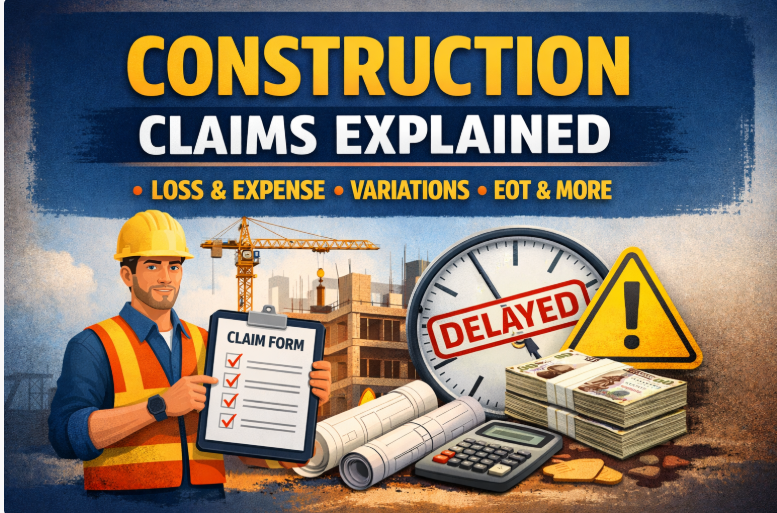
Construction Claims Explained: Loss and Expense, Variations, and Other Common Claims Every Professional Should Understand
In construction projects, things rarely go exactly as planned. Delays happen, designs change, prices fluctuate, and unexpected site conditions arise. When these issues affect cost or time, construction claims become unavoidable.
Unfortunately, many professionals, especially young Quantity Surveyors, contractors, and site managers, either misunderstand claims or avoid them completely. This often leads to financial losses, disputes, and strained relationships on projects.
This article breaks down construction claims in simple terms, with special focus on Loss and Expense claims, variations, and other common claims encountered on building projects in Nigeria and similar markets.
What Is a Construction Claim?
A construction claim is a formal request by one party (usually the contractor) seeking additional payment, extension of time, or both, due to events that were not originally allowed for in the contract.
Claims arise when:
The scope of work changes
The contractor incurs extra cost
The project duration is extended
The contractor is prevented from working efficiently
Claims are not cheating or unethical. When properly justified, they are a legitimate contractual right.
Common Types of Construction Claims
1. Variation Claims
A variation is any change to the original scope of work after the contract has been signed.
Examples include:
Change in design or drawings
Increase or reduction in quantities
Change in materials or specifications
Additional work not originally included
How variation claims work:
The change must be instructed (verbally or in writing)
The contractor prices the change using contract rates or agreed new rates
The approved amount is added to or deducted from the contract sum
Key point:
If work is changed without proper documentation, the contractor may struggle to recover the cost.
2. Loss and Expense Claims (Very Important)
Loss and Expense is one of the most misunderstood claims in construction.
A Loss and Expense claim is made when the contractor suffers financial loss due to delay or disruption caused by the employer or their representatives, not by the contractor.
Common Causes of Loss and Expense:
Late issue of drawings
Delayed instructions
Late possession of site
Suspension of works by the client
Design changes causing disruption
Employer’s nominated subcontractor delays
What Can Be Claimed?
Loss and Expense does not include profit on extra work. Instead, it covers actual losses, such as:
Extended site overheads (site staff, security, power, water)
Idle labor and plant
Additional preliminaries
Increased supervision costs
Financing costs due to prolonged project duration
Key Difference:
Variation claim = payment for extra work
Loss & Expense claim = compensation for inefficiency and delay
3. Extension of Time (EOT) Claims
An Extension of Time claim is made when delays occur that are beyond the contractor’s control.
Common grounds include:
Client variations
Late drawings
Exceptionally bad weather
Force majeure events
Delayed approvals
An EOT protects the contractor from:
Liquidated damages
Wrongful blame for delay
Important:
An EOT does not automatically give money. It only adjusts the completion date. Loss and Expense may be claimed separately.
4. Fluctuation Claims
In an unstable economy, fluctuation claims are becoming increasingly relevant.
A fluctuation claim arises due to changes in:
Material prices
Labor wages
Fuel and transportation costs
These claims are only allowed if the contract provides for fluctuations. If not, the contractor bears the risk.
5. Disruption Claims
Disruption occurs when work is carried out less efficiently than planned, even if the project is not delayed.
Examples:
Frequent changes to drawings
Working out of sequence
Stop-and-start instructions
Congested site conditions caused by others
Disruption claims often form part of Loss and Expense.
Key Requirements for a Successful Construction Claim
Many claims fail not because they are invalid, but because they are poorly prepared.
To succeed, a claim must show:
1. Contractual Entitlement
The contract must allow the claim.
2. Cause
What event caused the loss or delay?
3. Effect
How did the event affect cost, time, or productivity?
4. Evidence
This is the most critical part.
Essential Records for Claims
Professionals must keep:
Site diaries
Daily labor records
Plant usage logs
Correspondence (emails, letters, WhatsApp instructions)
Photographs
Approved drawings and revisions
Progress reports
Programs and updates
No records = weak claim.
Common Mistakes Professionals Make with Claims
Waiting too long before notifying the client
Relying on verbal instructions only
Mixing variation and loss & expense claims
Claiming estimated figures without evidence
Ignoring contract notice requirements
Why Construction Claims Matter
Construction claims:
Protect contractors from financial loss
Ensure fair risk allocation
Encourage proper project administration
Reduce disputes when handled professionally
For Quantity Surveyors, claims management is a core skill, not an optional one.
Final Thoughts from WeConstructHub
Construction claims are not about fighting clients—they are about protecting value and fairness on projects.
Whether you are a student, a site QS, a contractor, or a consultant, understanding claims like Loss and Expense, variations, and EOT will significantly improve your professional competence.
At WeConstructHub, we are committed to simplifying complex construction concepts and equipping professionals with practical knowledge they can apply on real projects.
WeConstructHub Marketplace makes buying construction materials easy, transparent, and trustworthy — while helping professionals get verified market prices they can rely on.











Comments
BMoCMeisWzzRzvfY EDrZacfURfFdzXywVcSnEIP 28 Mar 2026 04-40:pm
YpAIMCuHdOUqJjsD
Write a Comment